EHS Management Promotion
Head of Global Corporate Affairs serves as the Head of Global EHS Management Officer, overseeing EHS management across the group, while the Head of Global Sustainability serves as the Global Environmental Management Officer and the Head of Global Total Rewards and Well-Being serves as the Global Health and Safety Management Officer, promoting EHS management. Sustainability Committee, chaired by the Head of Global Corporate Affairs, in principle, twice a year discuss related to environmental, health, and safety (EHS); sustainability information disclosure; and social contribution. With respect to EHS, it deliberates on Short-, Mid-, and Long-term strategies, plans, and activities related to EHS management. The results of these discussions are escalated to the Executive Management Committee (EMC) and important issues are subsequently reported to the Board of Directors.
ISO 14001/45001 Certification
Optimization of the EHS management system (EHSMS)
The Daiichi Sankyo Group promotes the optimization of the EHSMS in accordance with the Standard for the Daiichi Sankyo Group’s Environmental Management Systems.
Operating (production) sites that use large amounts of energy for manufacturing in Daiichi Sankyo Group have acquired the international standard for the EMS, ISO14001 certification (See the table below). We have also acquired ISO14001 certification in a multi-site registration that integrates all production sites of Group companies in Japan in one certification scope.
Furthermore, in fiscal year 2024, Daiichi Sankyo Group domestic manufacturing sites (Hiratsuka Plant, Odawara Plant, Onahama Plant, Tatebayashi Plant and Kitamoto Plant) have acquired multi-site certification for ISO 45001:2018, the international standard for health and safety management systems.
Daiichi Sankyo Group domestic sites (Hiratsuka, Odawara, Onahama, Tatebayashi and Kitamoto plants) have already obtained ISO 14001:2015 certification (multi-site certification), the international standard for environmental management systems. With the acquisition of ISO 45001:2018 certification, we establish an integrated environmental and health and safety management system as an EHS (environment, health and safety) management system, and will work to further reduce environmental impact and environmental risks, and manage employee health and workplace safety.
We optimize its EHS management system in accordance with the Daiichi Sankyo Group EHS Policy to address environmental, health and safety issues and promote responsible corporate activities.
List of operating sites that have integrated ISO14001/45001 certification (as of the end of April 2025)
List of ISO 14001 Certified Sites (As of the End of April 2025)
EHS Internal Auditing (Environmental Auditing)
EHS Internal Auditing Based on PSCI
The Group implements EHS audits based on PSCI*1 for overseas production sites every three years. There were no critical findings in the audits from FY2020 to FY2024. The summary of the results is as follows:
Implementation period: March 2021 to March 2025
Number of sites: 12 sites
Number of sites with findings (excluding minor findings): 8 sites
Number of findings: 37 cases
Responding to findings
| Management System |
- Established Global BCP*2 Policy and BCP in each site
- Established relevant documents (regulations, SOPs, and guidelines, etc.) for each company based on the Global EHS Policy
|
| Environment |
- Strengthened disposal management of liquid hazardous waste
- Installed acoustic barriers to mitigate noise from the equipment.
|
| Health & Safety |
- Strengthened health and safety management through establishing/revising SOPs
- Mitigated exposure risks to body fluids for First Aid Responders through trainings, etc.
|
- *1Pharmaceutical Supply Chain Initiatives, non-profit organization which promotes sustainable procurement in the pharmaceutical and healthcare industry
- *2Business Continuity Plan
EHS Internal Auditing
Audits related to EHS management are conducted with three assessment approaches by the operating sites, the EHS management department (Sustainability Department and Human Resource Department) and ISO certifying bodies. These environmental audits supplement one another according to the situation at each operating site. Audits conducted by the Sustainability Department and Human Resource Department once every three years target all operating sites under the key theme of environment-related laws and regulations. In FY2024, audits were conducted at Tatebayashi Plant, Daiichi Sankyo Biotech Kitamoto Plant and American Regent. The audits confirmed that good compliance was being practiced in relation to environmental, health and safety related laws and regulations and that there were no concerns with the potential of leading to major risks.
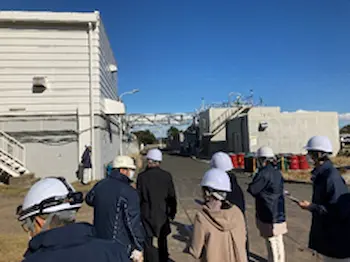
Conducting EHS internal audits
Response to Accidents and Other Emergencies
Plants and research facilities with particularly high environmental risks have prepared protocols and defined responses to emergencies, including the prevention and mitigation of environmental pollution due to disasters and accidents. They also conduct periodic training and emergency drills while maintaining the necessary equipment.
In FY2024, no environmental accidents that have a significant impact on the surrounding environment occurred.
Environmental Education and Awareness Raising Activities
Workshops for environmental managers and initiatives to optimize environmental management
Every year, we hold a workshop for environmental managers on different themes that are relevant at the time to provide specialized education and information for those responsible for environmental-related tasks in domestic Group companies. The theme for FY2024 was the chemicals management in business establishment.
Workshops on global warming countermeasures
We hold workshops for global warming countermeasures every year to provide specialized education and share information on energy-saving and global warming countermeasures targeting facilities and energy managers of our plants and research facilities. The theme for FY2024 was the perovskite solar cells. We will continue to plan and hold workshops to promote energy conservation and global warming countermeasures.
Environmental e-learning
We provide environmental e-learning programs for all Group employees. In FY2024, the theme was on Corporate Initiatives to Achieve Carbon Neutrality. In domestic group companies, the participation rate was 97.6%. For those who had not participated in the e-learning including new employees, we thoroughly informed them of and provided the voluntary e-learning program. The participation rate of the entire Group was 94.7%.
Environmental Art Contest
We implement environmental communication measures to improve employees’ environmental awareness. Every year in June, which is designated as “Environment Month” by the Group, a contest is held for artwork that gives the viewer an impression of the environment. We accept entries from Group employees and their families globally
For the FY2024 contest, we received a total of 568 entries from Group companies in Japan and overseas. Specifically, we received 126 entries from domestic Group companies and 35 entries from overseas Group companies in the image category; 337 entries in the senryu (humorous or ironic haiku) category targeting domestic Group companies; and 70 entries in the slogan category targeting overseas Group companies. We selected the top prize and SDG special prize winners, and held an online award ceremony.
One DS Climate Action Program
We globally carried out the One DS Climate Action Program for internal implementation of decarbonization management for all employees. The number of registered participants were 1,584 in FY2024. This program is conducted annually during the summer months from June to September. Since the launch of the Cool Choice Program in FY2013, approximately 15,000 employees have participated cumulatively.
Business Activity and Input/Output
Business Activity and Input/Output (Entire Group)
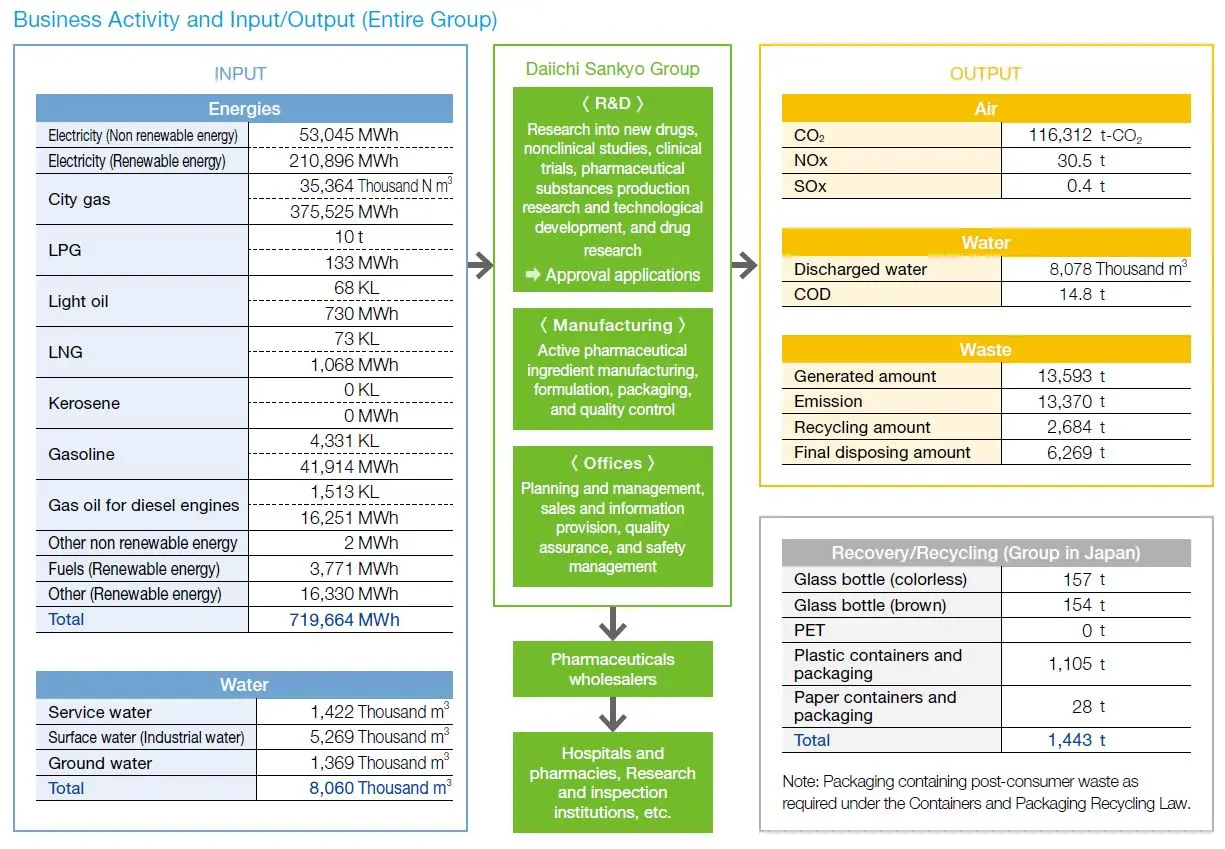
Data for each fiscal year is based on the company structure at that time
Environment Accounting (Group in Japan)
Environment Conservation Cost (Group in Japan)
Unit: million yen
- *Excluding depreciation expenses.
Economic Benefit (Group in Japan)
Unit: million yen
Environmental Conservation Benefit (Group in Japan)
Environmental Efficiency Index (Entire Group)
- *The figures as of FY2015 have been set to 100. Higher index shows higher level of efficiency.
Environmental Data Book
The Environmental Data Book 2025 contains information of the environmental data on our website as well as complementary information. Please see them in addition.
Environmental Data Book Back Numbers