Upon returning to Japan in 2010, he was transferred to the Biologic Research Laboratories and appointed as the research team leader of the ADC Working Group, which was led at the time by the late Dr. Toshinori Agatsuma.
The concept of antibody drug conjugates (ADCs) was originally proposed by Dr. Paul Ehrlich in the 1900s, but it had long remained impractical for clinical use. Against this backdrop, Daiichi Sankyo launched a research team in 2010 with the aim of establishing a new ADC technology. By 2012, the company had successfully developed its own proprietary ADC technology, which would go on to become the backbone of approved medicines and others in clinical development for a wide range of different cancers.
Reflecting on the reasons behind such rapid progress, Dr. Abe explains, “I believe the key to our success was the fact that a large number of researchers from different departments and fields came together, engaged in intense and uncompromising discussions that transcended organizational boundaries. At the same time, while it was an incredibly rewarding mission to lead multiple ADC projects simultaneously, I do look back and reflect as a manager at the time, that the burden placed on each team member must have been quite substantial.”
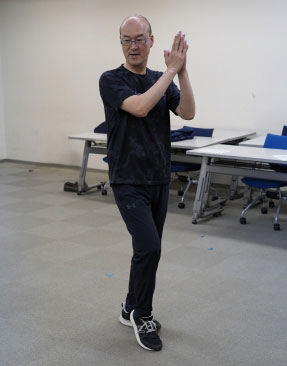
Dr. Abe at dance*2practice
In 2019, Dr. Abe was appointed Director of the Oncology Research Laboratories II, Research Function, R&D Division. He worked diligently to integrate the strengths of the former Daiichi Pharmaceutical Co., Ltd, known for its expertise in small-molecule drug discovery, and the former Sankyo Co., Ltd, which had expertise in biologics, thereby building a research organization that leveraged the advantages of both.
In 2023, to accelerate the development and execution of growth strategies for research, foster talent, and further promote open innovation, he led the establishment of the Research Innovation Management Department, and in 2024, this department was reorganized to strengthen support functions for research laboratories: it was split into the Research Innovation Planning Department, responsible for planning, strategy, and digital transformation initiatives; and a new Research Innovation Management Department, focused on research management and implementation.
As part of this reorganization, research staff who had previously been assigned to individual research laboratories were brought together under the Research Innovation Planning Department. This restructuring made it easier to share information and contributed to greater operational efficiency.
Dr. Abe emphasizes that speed is essential in the race to develop innovative new medicines ahead of the rest of the world—and achieving that requires an organizational design that enables it.
“Drug development involves many researchers,” he says. “But to create truly outstanding medicines, it’s crucial to build an environment where each individual can fully demonstrate their capabilities. We need a flat organizational structure where researchers from diverse fields can challenge one another, repeat hypothesis and verification, and reach sound conclusions through continuous collaboration.”
*2Every summer, a dance performance by regular employees, department heads, general managers, and executive officers takes place at the Shinagawa Research and Development Center in Tokyo
An Ideal Leadership Style: Unwinding with Golf, Reading and Movies
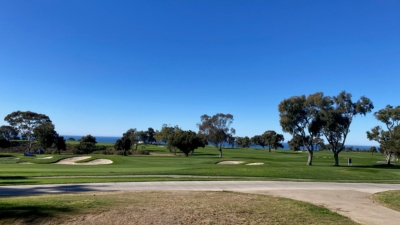
The golf course near the San Diego Smart Research Laboratory,*3
where Dr. Abe promised Dr. Agatsuma he would someday play
On his leadership style, Dr. Abe shares the following thoughts: “There are many different styles of leadership, but rather than pursuing a specific one, I believe it's more important to adapt flexibly—shifting between leadership and followership depending on the team composition and the situation—while encouraging each member to fulfill their role. I feel that this kind of flexible approach and mindset is what I currently need most.”
During his research stay abroad, Dr. Abe believed that physical strength was essential for eventually taking on leadership responsibilities. So, upon returning to Japan, he began learning karate with his son. More recently, he has discovered a new passion, golf, which he initially took up just for fun.
“I’ve been taking golf lessons from a professional at an indoor driving range lately, but my scores haven’t improved at all. Watching a video of my own swing, I was shocked by how far it was from the ideal form. It looks like this will be a long-term endeavor,” he says with a smile.
A lifelong reader since elementary school, Dr. Abe has long enjoyed historical novels, particularly those by Ryotaro Shiba. He recalls one book that had a profound impact on him: Kobo Abe’s novel “Kabe-The Wall,” which he happened to read during a hospital stay as a child.
“In the story, the main character wakes up one morning to find that he has turned into a wall. That shock has stayed with me ever since. It made me realize just how trivial my own worries and struggles were.”
Dr. Abe is also a film enthusiast, enjoying a wide range of movies—from the weighty works of director Akira Kurosawa, such as “Ikiru (Living),” as well as the classic, “Fūrin Kazan-(Samurai Banners),” to Hollywood action series like “007” and “Mission: Impossible.”
*3 A cutting-edge technology research facility established in San Diego, California, USA in January 2025. Click here for more details.
The Advanced Expertise Required as a Foundation for Researchers
“As I have mentioned, teamwork that transcends boundaries is essential in drug discovery. However, this presupposes that researchers with high levels of expertise and experience come together and collaborate on their work. In other words, for effective teamwork to be realized, each researcher must continuously strive to enhance their own specialized skills,” said Dr. Abe, reflecting on his career and experience. He emphasized that possessing advanced expertise is a minimum requirement for success as a researcher.
Even now, as he leads the research division, he maintains this belief and expresses his commitment to contributing to the future of drug discovery and the health of people around the world.