At the same time that the company was developing novel treatments for infectious diseases and chemotherapeutic agents for tuberculosis, Daiichi garnered national attention by becoming the first among its domestic pharma company peers to launch “Rutinon,” a vasodilator and cerebral hemorrhage prevention agent.
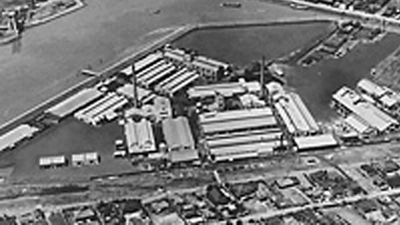
The Funabori Factory, which suffered minimal damage during
the war
In the aftermath of the war, Daiichi was forced to shut down or suspend operations at many of its manufacturing facilities. However, between 1946 and 1947, Daiichi successively restarted its Yanagishima, Funabori, and Hirai plants in Tokyo and resumed operations.
Notably, despite the structure sustaining an 80% loss, driven by the enthusiasm of employees determined to restore the plant, work on the Yanagishima plant proceeded around the remaining warehouse. They used stoves to burn firewood for heat, excavated pipes buried under rubble to restore the water supply, and worked tirelessly to secure gas supplies as quickly as possible.
By February 1947, the company had rebuilt its head office in Nihonbashi, which had been destroyed by fire, and had resumed full-scale operations, and in 1948, Daiichi introduced Theradiazine, an anti-infective drug.
This was followed by the launches of Pasnal, a chemotherapeutic agent for tuberculosis, in 1950 and Iscotin, a more potent drug, in 1952, enabling the company to steadily expand its business and establish its post-war foundation. (For more on Theradiazine, Pasnal, and Iscotin, see: Japan’s First Drug for Infectious Diseases and Development of Groundbreaking Tuberculosis Drugs)
Rutinon hits the market amid fierce competition in the pharmaceutical industry
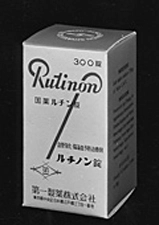
Rutinon at launch
In 1949, the Dodge Line fiscal and monetary contraction policy brought an end to hyperinflation, ushering in the era of disinflation. Various industries seized this opportunity to shift to a buyer’s market in terms of distribution and sales, and the economic controls that had been imposed for many years began to be lifted.
It was also a time when the pharmaceutical industry was finally recovering to pre-war levels in terms of production capacity and distribution. While this led to intensified competition, Daiichi successfully navigated these challenging times by focusing on its flagship product, Theradiazine, a drug for the treatment of infectious diseases.
Furthermore, in August 1949, Daiichi took the lead among its competitors and successfully commercialized “Rutinon,” a vasodilator and cerebral hemorrhage prevention agent*, manufactured at its Yanagishima plant. Introduced in simple red and white packaging, it was widely featured in the media and promoted by Daiichi as its first non-prescription drug (equivalent to today’s over-the-counter drugs).
Through extensive advertising campaigns in newspapers, posters, and outdoor advertisements, the product quickly gained considerable attention after its launch.
*Product category at the time of release
Overcoming the crisis of raw material shortages, it became a widely popular medicine
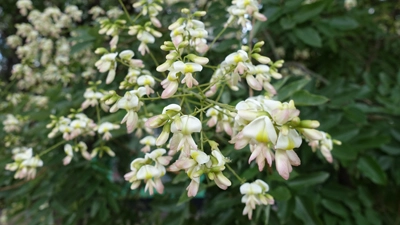
Japanese pagoda tree flowers used instead of buckwheat
flowers
The active ingredient in Rutinon is rutin, a compound found widely among plants. In 1943, for the first time, an American team led by Professor Griffith published a report stating that rutin had successfully restored normal blood pressure in patients with capillary fragility.
Prompted by this report, given that Daiichi had already been researching rutin since the early Showa period, under the guidance of then-President Shinoda, the company quickly moved to commercialize and mass-produce the product. However, despite its overwhelming popularity, a major obstacle quickly emerged: production could not keep pace with demand.
This was due to the fact that buckwheat flowers used to extract rutin, an ingredient in Rutinon contained only tiny amounts of the compound and procuring the flowers themselves proved difficult.
Recognizing the potential of Styphnolobium japonicum, also known as the Japanese pagoda tree, which has prominent levels of rutin in its flowers and buds, the company immediately began importing it from China.
With competitors also focusing on rutin, the company faced intense competition to be the first to market; however, it successfully overcame this challenge and was able to deliver the product to many people. The story of Rutinon’s shows how Daiichi’s passion for creating effective medicines never wavered, even in the harsh postwar environment.