Basic Policy
The Daiichi Sankyo Group recognizes environmental issues, including global warming and extreme weather, as critical challenges affecting our lives and work, and also as risk factors that may impact our long-term business activities. The Group believes that promoting environmental management will contribute to the development of a sustainable society and help establish a foundation for its long-term corporate growth.
We comply with the environmental conservation, health, and safety laws and international agreements of each country, while setting higher goals and striving to achieve them.
We will clarify the roles and responsibilities within the organization and establish an EHS management system to promote environmental conservation as well as health and safety assurance, and to facilitate continuous improvement.
We strive to enhance knowledge and awareness of EHS through education and awareness activities related to environmental conservation, health, and safety assurance.
We actively disclose information and engage in communication regarding environmental conservation and the assurance of health and safety, fulfilling our accountability to stakeholders.
In accordance with the above, we establish and implement the following as our basic EHS policy.
EHS Basic Policy
- Reduce environmental impact in the Group's business processes and supply chain, from research and development to production, distribution, use, consumption, and disposal
- Improve the working environment so that employees can work safely and maintain and promote their health
- Establish, operate, evaluate, and improve the EHS management system
- Comply with environmental and health and safety related laws and regulations
- Reduce EHS risks and eliminate sources of hazards
- Efficient use of resources and energy, reduction of greenhouse gas emissions, appropriate use of water and wastewater management, waste reduction and recycling, respect for biodiversity, appropriate management of chemical substances, and prevention of deforestation
- Prevent health hazards and occupational accidents
- Engage in EHS education and awareness-raising activities
- Participate in EHS communication and consultation with internal and external stakeholders
Vision & Goals
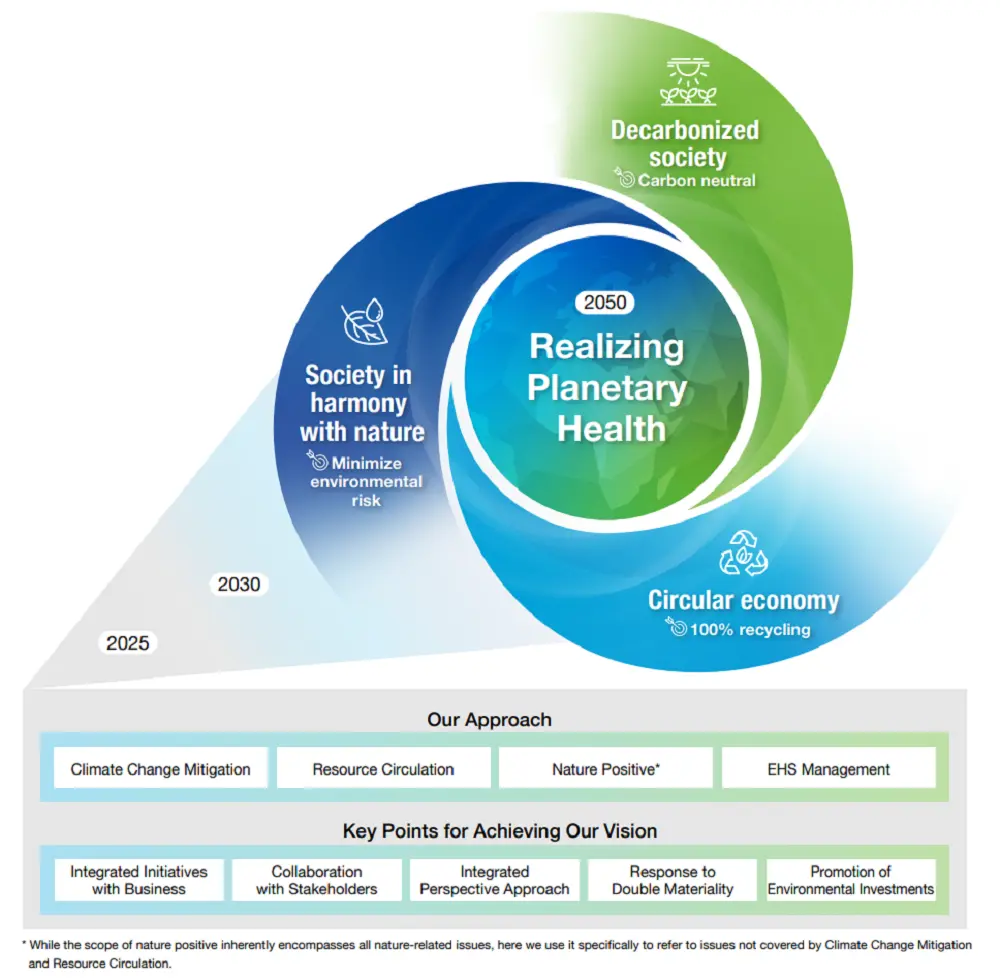
Daiichi Sankyo Group Environmental Management Vision 2050
- The Daiichi Sankyo Group’s mission is to contribute to people’s health by developing and delivering innovative medicines worldwide. The Group recognizes that its business activities may affect the environment, potentially posing risks to people’s health and well-being. The sustainable use of ecosystem services is an essential foundation for our business continuity. Guided by the belief that business activities intended to support people’s health must not harm our planet’s health, we promote a form of environmental management that enables both business growth and the minimization of environmental impact.
- The Group’s long-term vision for 2050 is to contribute to the realization of planetary health, where both the planet and people can thrive in good health. Planetary health reflects the recognition that human health and planetary health are closely interconnected. Guided by the Group’s purpose, “Contribute to the Enrichment of Quality of Life around the World,” we strive to realize a sustainable society by minimizing the environmental impact of our business activities while advancing initiatives that contribute to planetary health.
Three Goals to Achieve Our Vision 2050
- To achieve planetary health, we push a number of environmental initiatives guided by three goals: decarbonization, circular economy, and a nature positive society.
Long-term Targets for 2050
- The Group’s long-term targets for 2050 are achieving carbon neutrality to advance decarbonization, achieving 100% recycling to promote a circular economy, and minimizing environmental risks to fulfill our responsibilities in fostering a nature positive society.
- Carbon neutrality: We aim to achieve net zero across the value chain by 2050 by reducing Scope 1, 2, and 3 emissions by 90% from base year levels and neutralizing remaining emissions through the removal of an equivalent amount of carbon. This target is aligned with the net-zero standard approved by the Science Based Targets initiative (SBTi).
- 100% Recycling: We aim to achieve 100% recycling of recyclable materials while pursuing resource circulation initiatives and exploring recycling possibilities.
- Minimization of environmental risks: We aim to minimize environmental risks across the value chain by achieving environmental targets and strengthening EHS management.
Mid-Term Targets for FY2030 (6th MTP EHS Management Policies and Targets)
- To achieve the long-term targets, the Group established EHS management policies and objectives in the 6th Mid-Term Plan as a milestone toward FY2030.
- The policies and targets define approaches and targets for each of the following themes: Climate change mitigation, Resource circulation, Nature positive, and EHS management.
Key Drivers for Realizing Our Vision
- Initiatives aligned with business operations: We advance initiatives aligned with business operations to reduce environmental impact while enhancing our R&D systems to deliver medicines to more patients.
- Collaboration with stakeholders: Planetary health cannot be achieved through our efforts alone. We strategically collaborate with business partners, customers, communities, and other stakeholders to promote various initiatives.
- Initiatives with integrated perspectives: We promote initiatives from an integrated perspective, considering the synergies and trade-offs that exist among environmental issues and related measures.
- Response to Double Materiality: We assess key issues from both the impact of environmental and social issues on our Group’s financial performance and management and the impact of our business activities on the environment and society, and strategically promote initiatives to address them.
- Promotion of environmental investments: We actively promote environmental investments aimed at reducing environmental impact, including energy efficiency improvements, the introduction of renewable energy, and technological innovation.
Daiichi Sankyo Group Environmental Management Vision 2050 and Targets 2050
Mid-Term Targets for FY2030 (6th MTP EHS Management Policies and Targets)
Mid-Term Targets for FY2025 (5th MTP EHS Management Policies and Targets)
Our GHG emissions reduction targets certified by the Science Based Targets initiative (SBTi)
Daiichi Sankyo achieves certification for the greenhouse gas (GHG) reduction goal of "Net Zero Target" from the Science Based Targets initiative (SBTi)*1on December 1, 2025. This means our targets is recognized as a long-term GHG reduction target based on scientific evidence, aligned with the Paris Agreement’s 1.5℃ target under the SBTi Net-Zero Standard. The Daiichi Sankyo Group recognizes environmental issues, including global warming and the intensification of climate-related disasters, as serious challenges that threaten the realization of a sustainable society and the human health, as well as risk factors that impact the long-term business foundations, such as the stable supply of pharmaceuticals. Based on this recognition, we are proactively promoting environmental management. Moving forward, we will actively work on measures such as promoting energy conservation, utilizing renewable energy, and introducing decarbonization technologies, and collaborating with business partners to realize a decarbonized society.
Our GHG emissions reduction targets certified by the Science Based Targets initiative (SBTi)
- *1An global initiative for companies and financial institutions to respond to the climate crisis and contribute to achieving the Paris Agreement’s 1.5°C target and net zero. It advances setting science-based GHG reduction targets and verifies and certifies that those targets meet international standards. Partners include CDP, United Nations Global Compact, We Mean Business Coalition, World Resources Institute (WRI), and World Wide Fund for Nature(WWF).
- *2This includes suppliers in categories 1 (purchased goods and services), 2 (capital goods), and 4 (upstream transportation and distribution).
- *3After achieving the long-term targets, any remaining emissions (residual emissions) that cannot be reduced will be neutralized by an equivalent amount of carbon removal.
5-Year Business Plan (FY2021-FY2025)
5-Year Business Plan (FY2026-FY2030)
Materiality and KPI
Basic Biodiversity Principles and Action Guidelines
Sustainable Procurement