Initiatives for Biodiversity
The Group’s Basic Environmental Management Policy and the Mid-term Environmental Management Policy stipulate that business activities must consider biodiversity and ecosystem services. The Group has established the Basic Biodiversity Principles and Action Guidelines based on these policies. When this was established, the Group surveyed its initiatives on biodiversity, the use of natural resources, and status of efforts to comply with the Cartagena Protocol both inside and outside of Japan. Additionally, the Group assessed the relationship between its business activities and biodiversity and identified issues through an analysis of the Group’s risks and opportunities. (Please refer to the diagram “Map of corporate activities and biodiversity” below.)
The Daiichi Sankyo Group believes that biodiversity conservation and sustainable use of ecosystem services are essential in performing business. We promote raising awareness and understanding of employees, as well as the strengthening of environmental conservation activities in collaboration with business partners and private groups, to procure materials with less environmental burden, and to socially contribute towards biodiversity conservation.
Basic Biodiversity Principles and Action Guidelines
Basic Policy
- Our Basic Environmental Management Policy states that, “Safeguarding the environment is the bedrock of all Group operational management.” We have
therefore acted to prevent pollution and global warming and contribute to recycling. Through our initiatives, we have used biological resources properly to
minimize the impacts of our operations on biodiversity and have sustainably reduced chemical and other discharges.
- We will continue striving to preserve biodiversity and respect the principles of the Convention on Biological Diversity by adhering to the following
Biodiversity Action Guidelines, thereby enhancing social sustainability.
Action Guidance
1.
Actively promote to address biodiversity conservation in all business activity |
- Under take ongoing endeavors to avoid or reduce operational impacts on biodiversity, devoting particular attention to lowering the environmental impacts of air and water emissions and wastes.
|
2.
Identify the biodiversity impacts of ecosystem services, using those services sustainably |
- Recognize the operational importance of ecosystem services while understanding and minimizing their impacts on biodiversity, using those services sustainably.
|
3.
Use genetically modified organisms responsibly |
- Maintain biosafety by continuing to responsibly use genetically modified organisms in drug discovery and production in keeping with the Cartagena Protocol on Biosafety and national laws and ordinances.
|
4.
Access to Genetic Resources and the Fair and Equitable Sharing of Benefits Arising from their Utilization |
- Comply with the Convention on Biological Diversity, the Bonn Guidelines, and other relevant rules to access and utilize genetic resources of the provider countries appropriately and to share benefits arising from their utilization in a fair and equitable manner.
|
5.
Communicate with stakeholders and improve in-house awareness |
- Foster biodiversity preservation by communicating and liaising better with public and private entities.
- Educate employees to better understand how operations affect biodiversity and encourage internal and external efforts to safeguard biodiversity.
|
Map of Corporate Activities and Biodiversity

An enlargeable image opens in a separate window
Ecological Footprint
We assess the ecological footprint (EF), an indicator of biodiversity, jointly with experts from the NGO Global Footprint Network, to examine all environmental burdens in the business activities of Group companies in Japan. The assessed EF is used as a comprehensive indicator of environmental burdens, including those related to biodiversity, by reviewing and monitoring long-term changes in the relationship between the reduction of environmental burdens and biodiversity conservation (trade-off) in the Group.
This initiative has been recognized as an action for achieving the Aichi Target (20 targets) that was adopted at COP10 (the 10th Meeting of the Conference of the Parties to the Convention on Biological Diversity in Nagoya) and has been registered on the Nijyu-Maru Project as well. In addition, it was introduced as an example of monitoring biodiversity in the Guidelines for Private Sector Engagement in Biodiversity (Second Edition) issued by the Ministry of the Environment of Japan.
Initiatives for Biodiversity Conservation
Conservation for rare species of plants
To preserve the golden orchid (designated as critically endangered Type II in the Japanese Ministry of the Environment’s Red Data Book) and the silver orchid, we have prohibited entry into the forested area of the property at the Tatebayashi Biopharmaceuticals Center where the plant naturally grows (approximately 1,000 m2). The continued conservation effort has been resulted in an increase in the population of the species and expansion of breeding range.
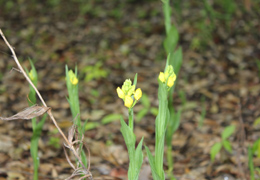
Golden orchid
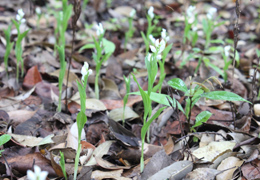
Silver orchid
Greening in harmony with the surrounding environment
The Kitamoto Office of Daiichi Sankyo Biotech Co., Ltd. engages in environmental conservation that considers the surrounding natural environment and ecosystem and implements sound insulation and greening in harmony with the neighboring Kitamoto Nature Observation Park.
Recognized for its various diversity-friendly initiatives, the office was given the 7th Sainokuni Green Plan Award in 2015. The award is granted by Saitama Prefecture to facilities that have achieved excellent greening and sound maintenance.
The office continues to engage in environmental conservation through greening and other ecosystem protection measures.
Activities to nurture biodiversity
In recent years, the population of pollinators such as honeybees and butterflies has been on a decreasing trend around the world due to the effects of deforestation, agricultural chemicals, global warming, and other issues. At our Pfaffenhofen Plant in Germany, we cooperate with Pfaffenhofen in Bloom -an initiative started by the city of Pfaffenhofen aimed to increase the pollinator population- and we are actively working on encouragement of biodiversity on the plant premises. We are planting many flowers in the approximately 3,200 m2 area as an environment where honeybees and other insects can inhabit. In addition, in April of 2022, Daiichi Sankyo Europe (Munich, Germany), one of our overseas group companies, started planting one tree per every new IT device, and approximately200 trees had already been planted. To promote this initiative, the company has secured enough land in Germany to plant approximately 3,000 trees, thereby working on achieving the Sustainability IT.
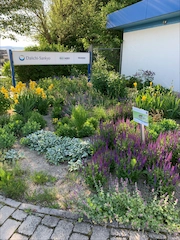
Planting in the premises
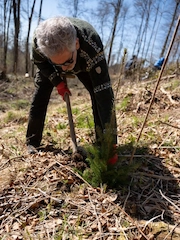
Afforestation through sustainable IT
Participation in 30by30 Alliance for Biodiversity
The Daiichi Sankyo group participates in 30by30 Alliance for Biodiversity launched in April 2022 by the Ministry of the Environment of Japan. 30by30 is a goal that aims to conserve or protect at least 30% of land and sea by 2030, thereby contributing to the conservation of biodiversity. We will promote initiatives to contribute to 30by30, including the implementation of e-learning programs to raise employee awareness and understanding of biodiversity and the setting of targets for biodiversity conservation.
Participation in Keidanren Initiative for Biodiversity Conservation
The Daiichi Sankyo group has endorsed the "Keidanren Declaration for Biodiversity and Guideline*1" advocated by the Japan Business Federation and the Keidanren Committee on Nature Conservation, and have participated in the " Keidanren Initiative for Biodiversity Conservation*2" We will promote initiatives to contribute to transitioning nature positive world, including the analysis and disclosure in line with TNFD recommendations and the setting of targets for biodiversity conservation, the initiatives to contribute to 30by30, the implementation of programs to raise employee awareness and understanding of biodiversity.
*1Keidanren Declaration for Biodiversity and Guideline
https://www.keidanren.or.jp/en/policy/2023/082_proposal.html
*2Keidanren Initiative for Biodiversity Conservation
https://www.keidanren-biodiversity.jp/logo_en.php
Environmental Supply Chain Management
Business Partner Code of Conduct
The Group has set out the Business Partner Code of Conduct (BPCC) in April 2019 in relation to the Daiichi Sankyo Group Procurement Policy, in line with the revision of the Daiichi Sankyo Group Corporate Conduct Charter.
This BPCC sets out expectations for the promotion of sustainable procurement to business partners that provide products and services to us. In the BPCC, the environment-related items are as follows(see 4. Promoting Environmental Management).
4. Promoting Environmental Management
(1) Reduce greenhouse gas emissions
(2) Appropriately manage waste and emissions
(3) Prevent and mitigate spills and releases
(4) Promote energy and resource conservation
(5) Support biodiversity
The Daiichi Sankyo Group requests its major business partners to conduct a Sustainable Survey every three years based on the Business Partner Code of Conduct, in order to deepen their understanding of our Group’s thinking and strengthen communication with them. For more details.
"Supplier Engagement Leader" in the CDP Supplier Engagement Assessment
International environmental NGO CDP Chas recognized our efforts to address climate change through our supply chain and our initiatives to reduce greenhouse gas emissions, designating us as a "Supplier Engagement Leader" in the Supplier Engagement Assessment (SEA) for six consecutive years. CDP SEA assesses companies on their performance on governance, targets, Scope 3 emissions, and value chain engagement in the CDP climate change questionnaire.
Environmental Supply Chain Management
Choice of raw material or components that have a lower environmental footprint
(1) Environmental impact assessment of pharmaceutical manufacturing processes: We are operating 2 different platforms to evaluate environmental impact of our drug manufacturing process. First, in our synthetic API manufacturing, we incorporate environmental impact assessments into the design of the manufacturing process at each development stage. We evaluate toxicity and hazardousness, energy consumption, and the amount of waste generated, etc. at each stage of development. Based on this evaluation, we identify the items with significant environmental impact and develop manufacturing processes that are more environmentally friendly. Secondly, in addition to the chemical synthesis process evaluation, Bio Solve indicator platform for cost and sustainability for biomanufacturing contributes to improving the environmental impact through process design by quantifying CO2 emissions of processes (example of applied process: continuous purification).
(2) Switching packaging materials to biomass plastics : To reduce environmental impact, We are promoting a switch from petroleum-derived plastics to biomass plastics for packaging materials such as the inner bags of injectable drugs, plastic trays for injectable drugs, vial break-proof packaging for injections, plastic bottles, and plastic film for PTP (Press Through Package) sheets.
Direct operation, production & manufacturing
(1) Enhancing environmental performance through the environmental management system (EMS): Daiichi Sankyo Group promotes environmental performance improvement through the operation of the Environmental Management System (EMS) based on the Standard for the Daiichi Sankyo Group’s Environmental Management Systems. Production sites that consume substantial of energy for manufacturing in Daiichi Sankyo Group have acquired ISO 14001 certification, which is the international standard for EMS, and production facilities that have not yet acquired ISO 14001 certification are working toward acquiring it. At all sites, including these production sites, we set annual environmental targets and are work on reducing for energy, water, and waste and work to reduce them.
(2) Reduction of environmental impact through reducing of raw material use, waste, and expired inventory: To minimize the environmental impact of our business activities, we are working on the following initiatives aimed at reducing raw material use, waste, and expired inventory.
・Developing an mAb manufacturing platform that can utilize common raw materials to manufacture different clinical trial materials
・Repurposing expired raw materials for manufacturing to research purposes
・Establishing highly productive processes for mAb manufacturing, such as continuous purification process
・Selecting purification resins with high-binding capacity and long-life
・Optimizing the mRNA synthetic process to increase production volume per batch, resulting in minimizing the amount of reagents and single-use materials used
(3) Reduction of Environmental Impacts from Wastewater: We established "wastewater guideline" to ensure that highly active substances contained in factory effluent are at levels that have no impact on the human body and the ecosystem. Based on this wastewater guideline, all factories and research facilities in Japan conduct annual WET tests (Whole Effluent Toxicity tests) to evaluate the impact of many chemical substances that are not classified as regulated materials, including active pharmaceutical ingredients, as well as their effects on complex ecosystems. These tests ensure that there are no significant environmental impacts. At Hiratsuka and Onahama site, we have been incinerating high potent wastewater discharged from the manufacturing lines off-site, but we have invested on environmental-friendly biological wastewater treatment facility on-site.
(4) Confirmation of information on chemical substances in raw materials: When concluding a quality contract, we request suppliers to submit SDS (Safety Data Sheets) to confirm information on chemical substances contained in raw materials (properties, hazards, toxicity, and handling, etc.).
Distribution, storage and transportation
Regarding commercial distribution, we are promoting the following initiatives: (1) Installation of solar power generator at warehouse, (2) Reduction of CO
2 emission by joint deliveries, (3) Utilization of recyclable pallet, (4) Reduction of paper/ink by downsizing shipping label, (5) Renewal of distribution facility which meets global security standard, and (6) Modal shift of transportation.
For safe handling of products, we share SDS (Safety Data Sheets) with drivers and business partners who transport our products.
Use phase – operation and servicing/maintenance
We are reducing obsolescence rates of drugs in clinical trials by sharing clinical trial materials across multiple protocols. In addition, we have reduced the amount of expired control drugs by procuring drugs with longer expiration dates in smaller quantities, more frequently.
End of life management
Daiichi Sankyo Healthcare has been running a demonstration project in Yokohama City since October 2022, collecting and recycling used "Medicinal Sheets" (PTP sheets). Over about a year, we collected 1.08 million sheets (1,077 kg), significantly exceeding our initial target. We have continued these efforts and as of the end of April 2025, we've gathered about 10.86 million sheets (10,859 kg), expanding our collection points from the initial 30 to over 100. We're currently upcycling these materials into stationery and board products, and we’re also looking to implement the project in new cities following Yokohama. This initiative aims to raise awareness that used "Medicinal Sheets" are recyclable resources and to create a system for resource circulation.